
There are a lot of piezo ceramic indicatiors during the product tests.
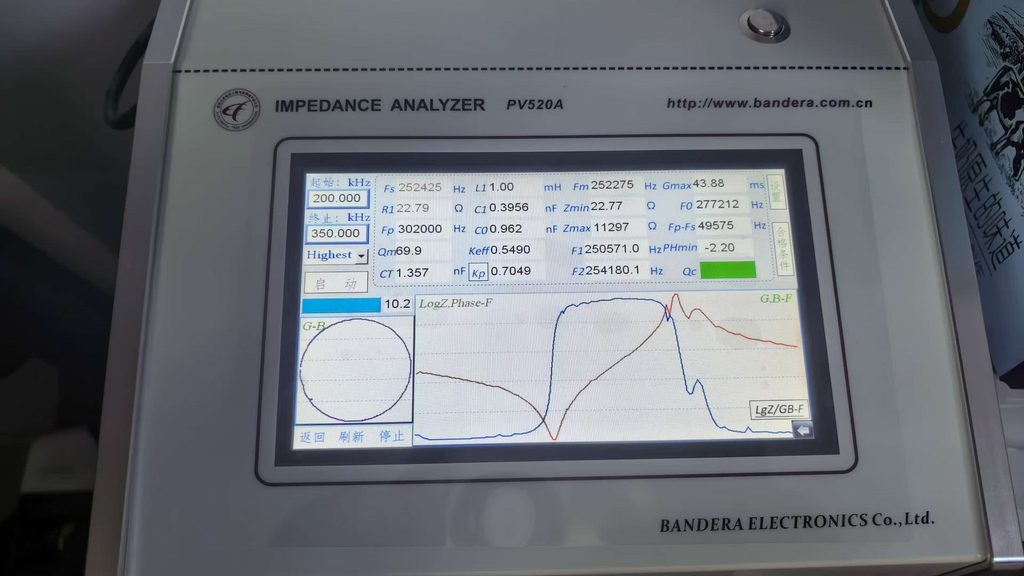
Lets see how these piezo ceramic indicatiors affect the downstream applications.
d33: Under the positive piezoelectric effect, d33 affects the output of mechanical energy to electrical energy. The higher d33, the stronger ability of the piezoelectric ceramic electricity output .
Under the inverse piezoelectric effect, d33 affects the degree of vibration deformation of the piezoelectric ceramic sheet. The higher d33, the greater deformation of the ceramic sheet itself.
Specific application: If you want to make a piezo ceramic igniter, the pressure on the hand is converted into electrical energy output, so a higher d33 value is better. The general requirement is greater than 420.
Piezoelectric sensors such as hydrophones, flow meters, and non-destructive flaw detectors use the inverse piezoelectric effect. The higher the d33, the higher the receiving sensitivity.
If it is used for an piezoelectric actuator, the displacement will be larger under the same driving voltage.
However, when making piezo ceramic devices, we must consider it comprehensivly. In addition to d33, other indicators also need to be considered. The first big aspect to consider is hardness. Generally, piezoelectric ceramics are generally divided into below types:
PZT-4, generally hard
PZT-5A Semi‑hard
PZT-5B Semi‑hard
PZT-5H Soft
PZT-5J Soft
PZT-8 Very hard
PZT-801 Very hard
For example, to make an industrial ultrasonic cleaning transducer, you need to choose PZT-8 or PZT-801 with high hardness. The ophthalmic phacoemulsification handle must also use PZT-801. We can’t just check one d33 index.
The relative dielectric constant index is also an important one often used in piezoelectric ceramics. It is not the capacitance value, but it will directly determine the capacitance. The higher the dielectric constant value, the greater the capacitance.
For applications such as flow meter probes and vibration sensors, the dielectric constant is high and then capacitive reactance is lower, making it easier to match the input impedance of the preamplifier. At the same time, the charge generated by the same force is larger (cooperating with d33), and the receiving sensitivity is easier to increase.
At the transmitting end of the reversing radar probe, the dielectric constant should not be too high and the capacitance should not be too high.
Piezoelectric motors require higher dielectric constant and larger capacitance.
Mechanical Quality Factor represents the amount of energy loss during piezoelectric ceramic vibration.
High QM means that the energy loss of piezoelectric ceramics is small during viberation. Therefore, the heat is also small, and devices that need to work for a long time like high QM. For example the Industrial ultrasonic cleaning and ultrasonic welding devices.
Flaw detector probes, B-ultrasound, and flow meter probes require medium to low QM.
Generally, the Curie temperature of materials under the KNN system that can be commercially applied is not high, most of which are 280 degrees.
Under the PZT system, the highest Curie temperature is PZT8 material, which can reach 350.
In order to adapt to high operating temperatures, there are now some ultra-high temperature piezoelectric ceramics CBN and calcium bismuth niobate. Mostly used for high temperature vibration sensors, gas/engine high temperature detection.
Curie temperature, this is a dangerous indicator. It represents the Max operating temperature of piezo ceramics. For example PZT‑4: ≈320 °C. This means that when the PZT ceramic sheet reaches 320°C, it will completely lose the piezoelectric effect and cannot be recovered. So it is a risk indicator. Even if it does not reach 320°C, if it is close to 320, such as 290°C, the performance of the piezoelectric ceramics will be unstable and unable to work properly.